

Review: Wicked
Wicked is a visually stunning film adaptation of the beloved Broadway musical, offering a thrilling experience for musical theater fans.

All views expressed are my own and do not necessarily reflect those of my employer.
Wicked
Released: November 22, 2024
Directed by: Jon M. Chu
Written by: Winnie Holzman, Dana Fox
Starring: Cynthia Erivo (Elphaba Thropp) and Ariana Grande-Butera (Galinda Upland)
My rating: ⭐⭐⭐⭐⭐
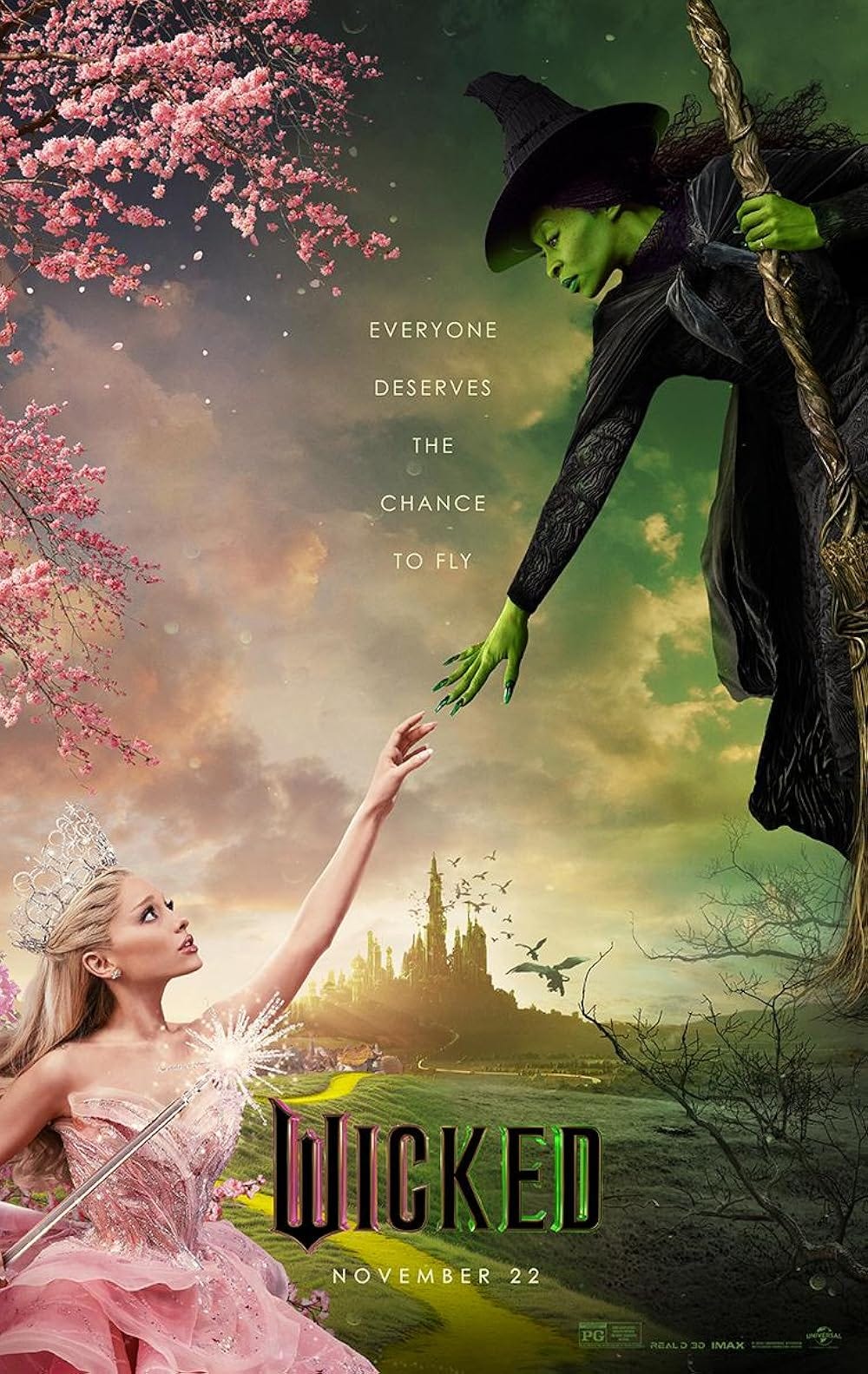
Wicked opens with a callback to 1937’s The Wizard of Oz. Paying homage both to the film that started nearly a century of sequels, stage adaptations, and fan fictions, and to the fact that the audience will be watching a movie musical. And Wicked is unabashedly a movie musical. There’s no lamp-shading by characters asking why people are singing. There’s no separating the music from the story. Singing and acting and dancing are irrevocably intermixed in this movie—as they should be.
If you don’t know already, Wicked is the movie adaptation of the first half of the beloved Broadway musical of the same name. Fans of the musical will be disappointed that they have to wait an entire year to see the second half, but they will be thrilled by this film. If you don’t like musicals, this movie is not for you, in the same way that a stage performance of The Phantom of the Opera or Hairspray would not be for you. That isn’t a dismissal—all are welcome to see the movie, and I bet many will enjoy it. But Wicked is not here to pander or be liked by everyone. It is a goddamn musical, and you can either accept it or go on about your day.
I thoroughly enjoyed this theater experience. It’s up there with seeing your favorite superhero in live action on the big screen for the first time. The acting is superb, the choreography is entrancing, and the singing is world class (most of the time—we’ll come back to this). The costumes are good, the sets are stellar, and the effects are almost seamless. I recommend Wicked for basically everyone, except those people who don’t like musicals.
Let’s start at the beginning.
If you don’t know the story of The Wizard of Oz, this is going to be a bit difficult, so maybe look that up first. Wicked opens within a day or two of Dorothy melting the Wicked Witch of the West and returning to Kansas, after the Wizard floats away in his hot air balloon. Glinda, the Good Witch of the North, floats into Munchkinland to announce the Witch’s demise. She and the Munchkinlanders ponder the source of evil, and Glinda shares the Witch’s childhood history—a green baby born out of wedlock.
As Glinda turns to return to the Emerald City, a woman in the crowd asks, wasn’t the Good Witch friends with the Wicked. Glinda hesitates but affirms her guess, saying they crossed paths at school—Shiz University. Her ensuing memories are where the majority of the movie takes place.
As a student, Glinda was known as Ga-linda. Instantly popular and beloved, she is thrown off-kilter when she meets Elphaba—a green-skinned girl acting as chaperone for her wheel-chair bound little sister, Nessarose. Galinda’s composure is further unraveled when Elphaba, in a fit of anger and confusion, accidentally reveals powerful magical abilities—catching the attention of Galinda’s favorite professor, Madame Morrible.
We shift to Elphaba’s point of view, as she ponders what attending Shiz and studying sorcery could mean for her life. She has always admired the Wizard but thought she would never have anything to offer, given her off-putting green skin. Her daydreaming ends in a nightmare, when she and Galinda spend their first night together as roommates. The two girls could not be more different—one boisterous and colorful, the other studious and muted—and the rest of the school immediately backs Galinda in her jealousy and loathing for Elphaba.
Later, another student joins the school—Fiyero, a young man from Vinkus (Winkie country). Everyone at Shiz (except for Elphaba) is immediately infatuated with Fiyero and his laidback, brainless approach to life. As the entire school prepares to go out dancing, Galinda gives Elphaba an ugly, pointed black hat as a joke, to make her look foolish at the party.
Let’s pause here. This sequence goes with the song Dancing Through Life, one of the show’s biggest song and dance numbers. It’s used to condense a lot of information into a short amount of time, which is the magic of musical theatre. In this sequence:
we get to know Fiyero,
Galinda and Fiyero become a couple,
Boq and Nessarose become a couple (although Boq pines for Galinda),
Elphaba attends her first party,
and the entire dance team gets to strut their stuff for the audience.
As much as I enjoyed this number, it is also where the movie’s main trouble arises, which is Fiyero’s singing. And calling it the movie’s main trouble makes it sound worse than it is. Jonathan Bailey (who plays Fiyero) is not a very good singer. He is a very good actor, and a surprisingly fluid dancer, but singing is the weakest link of his triple threat. I say surprising because I don’t expect most screen actors to be good dancers, but he is clearly extremely comfortable in his skin and in front of the camera.
Next to the two women, Fiyero is the third main part. He is the third point to their love triangle, he drives the story forward more than once, and he is the third most important singing role. When you have two vocal power houses like Cynthia Erivo and Ariana Grande, it is going to be very hard for anyone to match up…and Bailey doesn’t quite get there.
Now, calling his vocal performance the weakest of the three is kind of like saying the North Star isn’t as bright as the Sun: technically true, and critical, but not exactly in his control. The strength of his dancing and acting won me over. I love him as Fiyero…but I would have been open to a dub for his singing. A dub might be too far…he wasn’t bad…but there are better singers available.
Back to the story. Elphaba arrives at the party wearing Galinda’s horrific hat. Through the power of dance, the two girls bond—Galinda realizing that Elphaba cares deeply what others think, but she hides it behind layers of cynicism and sarcasm.
Let’s pause again because I think their dance deserves some additional time. People who don’t like musicals often struggle with the singing, and people who do like musicals can struggle when there’s dancing—just dancing. There’s an old musical theatre saying along the lines of “when the emotion is too big for words, you sing, and when the emotion is too big for song, you dance,” and that is the ethos behind Wicked. You can find it mentioned in interviews with the score and book writers.
Dancing Through Life has plenty of big dance moments—so do No One Mourns the Wicked, What is This Feeling, and One Short Day—but nothing is as meaningful as the pas de deux between Elphaba and Galinda. In the span of a few physical phrases, the two girls accept each other’s differences, apologize for their cattiness, and promise to do better by each other. All of these nuances are captured in Erivo and Grande’s eyes, faces, and movements. Dancing is just as important to this story as signing or acting, and the film manages to capture its ancient, beautiful, and deeply human magic.
After their night out, Galinda and Elphaba continue to bond. Grande has the opportunity to strut every one of her skills during Popular, where she weaves deftly between singing, dancing, and comedic timing. I didn’t think the pop star would have it in her, and she blew me away. She might be my favorite part of the movie, behind only the stellar sets and sound production.
Galinda joins Elphaba’s sorcery studies, although she has no clear talent in that direction. This was an olive branch on Elphaba’s part, as a thank you to Galinda for helping Nessarose enjoy the party. One of their professors is dismissed without warning—a Goat1 named Dr. Dillamond. Animals are being removed from positions of authority, by order of the Wizard. In his place, a new professor arrives with a Lion cub. In a burst of sadness and fury, Elphaba freezes the entire class in a sleeping spell—except for herself and Fiyero. The two escape with the cub and form a tentative bond through their rebellion.
Soon after, Elphaba is invited to meet the Wizard in the Emerald City, and she convinces Galinda to join her (now Glinda, in honor of their Goat professor who couldn’t pronounce her name properly). The two enjoy a marvelous movie montage, where a surprise cameo from the original Broadway leading ladies interrupts only slightly. I enjoyed the additional bit of background information they provide. If you want to offer that kind of fan service, at least they handled it gracefully.
The two girls arrive at the Wizard’s court, only to face the same shock as Dorothy would, years later. The Wizard is an old fraud. He doesn’t have any magical power, he can barely hold on to political power, and he is purposefully setting Animals up for suffering. He knows that people won’t turn against him, if he gives them another enemy to focus on instead.
Elphaba recoils from the Wizard’s schemes and flees with the Grimmerie—an ancient, unspeakable book of spells that the Wizard claimed to be able to read. Glinda, less resolute than her friend, is sent after Elphaba to retrieve her and the book. Elphaba tries to convince Glinda to leave with her, bewitching a broom to carry them, but Glinda refuses. The two wish each other well on their chosen paths, and the movie ends as Elphaba flies off with her broomstick, black hat and cape, and book of magic spells.
I didn’t know that the movie was going to end here, although once One Short Day began (the song for their day in the Emerald City), my internal clock told me that there was no way they were going to do this whole show in one film. I wish they had done some kind of intermission and released both halves together…but I’m not mad about it. This gives the studio an entire second dip into those box office sales.
At least it’s only one year away, and they didn’t wait to film the second half until after seeing the first’s results. Thank you, Universal Pictures, for trusting that this movie would do well enough to secure the second release date a year in advance. Your instincts were correct, and I can hardly wait to see what comes next.
You might not pick this up in the movie/musical, but in the source material, Animals are different from animals. Animals can talk and think, and are basically human, but animals cannot. You’re also supposed to pronounce the word slightly differently: Animal instead of animal.