

Sometimes Weird Movies are Just... Weird
On the 2021 film "Agnes"

I like weird movies. In my family we call them Karin Movies, which roughly translates to “interesting, but not straightforward enough to be a crowd-pleasing popcorn movie.”
The 2021 film Agnes was too weird for me.
I literally finished watching it 5 minutes ago, and I had to come sit down and process it. So, that goes in its plus column: it’s so weird I have to talk about it.
But.
I didn’t have a good time.
I didn’t enjoy watching it. I almost gave up.
Another point in its plus column: it kept me from giving up on it.
But then it ended. And I wish I had given up on it.
I feel like I wasted my precious movie-watching time on waiting for Agnes to fulfill its potential.
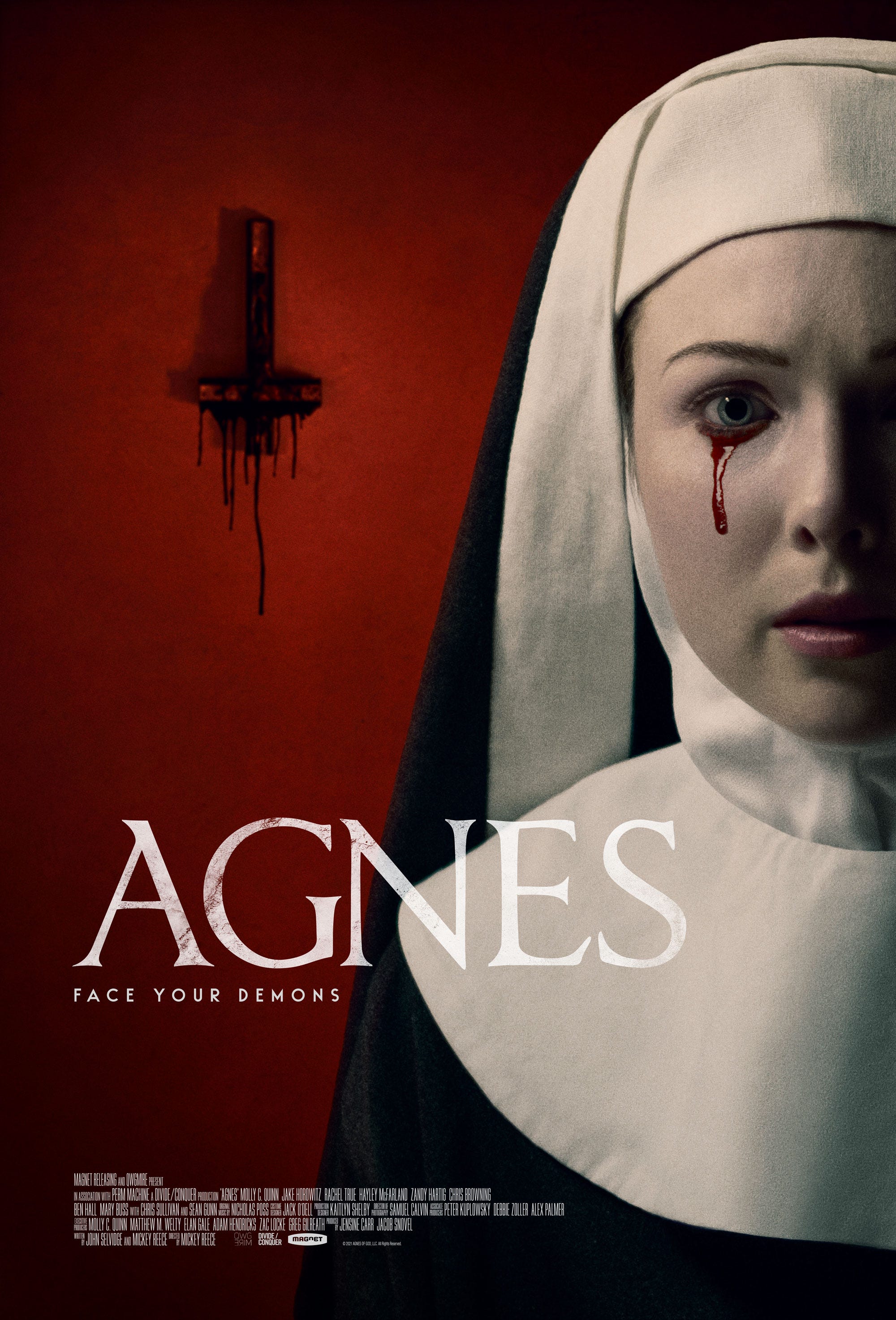
You see in that poster? How the blood tear looks like it was drawn on? It doesn’t actually connect to her tear duct? That’s the movie.
Agnes is about Mary
Spoilers ahead, but don’t worry, I don’t recommend watching this movie.
The movie opens in a secluded convent, where a young nun, the titular Agnes, begins lashing out, violently. Desperate, the nuns call in reinforcements to perform an exorcism. They arrive in the form of a disaffected priest and his former pupil, an innocent soon-to-be-priest.
Everything starts pretty normal; only a couple of unexpected filmmaking choices hint that things are going to get weird.
The pair of almost priests arrive at the convent, where they are reluctantly allowed in. Some of the sisters think the priests are attractive, while the Mother Superior almost doesn’t let the un-ordained man stay because he could be a temptation for the sisters.
Soon enough, they take on the demon. In the background, Sister Mary is fulfilling her cleaning duties, while poltergeist-like events happen around her (cups falling, doors opening and closing, etc.). Such events are usually associated with the possessed, confusing whether Mary is actually carrying the demon or maybe both girls are.
All goes well until the next morning when the not-actually-recovered Sister Agnes bites off a chunk of the priest’s nose. Feeling trapped, he calls in another exorcism expert: an excommunicated priest who claims to have grown up with a demon-possessed sister.
Meanwhile, Sister Mary is assigned the duty of nursing Sister Agnes. The two are close, and Agnes convinces Mary to remove her wimple, so she can be comfortable. They share secrets: Mary, that she had an underage pregnancy and lost her son; Agnes, that she fell in love with her teacher and then left him. Later, when Mary asks the Mother Superior to see how recovered Agnes is, the older woman calls Mary a slut for being undressed with men in the house.
This new “priest” arrives to take on the demon, and Sister Agnes kills him. The Mother Superior also seems to die of a heart attack during the murder. Mary leaves the convent.
Here, the movie takes a turn. Mary is living in a run-down apartment and working at a drab grocery store. As she goes about her life, we see characters that appeared to her as visions during Agnes’s possession.
She struggles to pay rent, takes on multiple shifts and multiple jobs, while avoiding advances from her manager. One night after work, she spots a sign promoting a comedian: Sister Agnes’s former lover.
Mary sees the show and can’t stop laughing the next day. Later, the comedian, Paul, asks Mary on a date. The two connect, and back at his apartment they start kissing, which ends abruptly when Mary bites a hole in his cheek—echoing Agnes’s attack on the priest.
Fearful, Mary asks the church to help her get in touch with the priests from Agnes’s exorcism. She meets with the now-ordained young priest and asks him how she can connect with God on Earth. Not through scripture or teachings, but true “connection,” she says while holding her hands together.
The priest explains that life is like the sandwich he’s eating. There’s stale bread and flavorless tomatoes and limp lettuce, but inside is what you’re really there for: the meat. Because the meat exists, you can make your way through the lackluster toppings, and you can imagine a better sandwich.
And that’s…basically where the movie ends. There are a few more lines of dialogue, but that’s it. The final scene of the movie is a priest likening Jesus to deli meat while a former nun looks on, unimpressed.
The problem is my words have to make sense
When I write it out like that, it kind of sounds like this movie has a story. But it doesn’t, really. Yes, those events happen in that order, but the movie never feels like it has a plot. It’s just a series of scenes. Unfortunately, in order to convey the film to you, I have to use English words and sentences that convey meaning. The film did not have such constraints.
The best way I can evoke the feeling of watching this movie is to imagine one of those 3D eye books or a watercolor kaleidoscope. The shapes and colors swirl, occasionally forming something that might be an image. And then, just as you’re sure it’s about to snap into clarity, the lights go out. That’s watching this movie.
I think there’s something here. I think the writer/director wanted to say something, he just forgot to actually say it.
Now, movies don’t have to speak their themes. And, like I said, I like weird movies. I have weird movie chops. I loved Saint Maud. I enjoyed I’m Thinking of Ending Things and I Saw the TV Glow. I was too emotionally affected by Melancholia to finish watching it.
What I’m trying to say is: don’t @ me, nerds. I understand weird art films.
But those movies had clear themes, even if I didn’t always understand them. Saint Maud’s theme clicks into place in the literal last second of film. And yet, you can follow the movie and its ideas all the way through.
I didn’t get I’m Thinking of Ending Things until maaaybe the final 10 minutes, and even then, I understood it better after listening to a review. I still enjoyed watching it and picking up on the clues and motifs the director wove throughout the “story.” (I believe that movie doesn’t actually have a narrative, but you can still intuit what’s going on. Movies don’t have to have a straight A to B to C story to be invigorating.)
I Saw the TV Glow has a masterful blend of allegory and real story. The film has a basic plot for you to follow, but the real meat is in the metaphorical layer that’s draped over the narrative’s bones.
What I’m saying is, movies don’t have to be straightforward to make sense. They can have a very clear plot or basically no plot and still convey a message and/or evoke feelings in their audience.
Agnes doesn’t do that. The feeling it evokes in me is disappointment and regret.
And I hate saying that. I hate feeling like I’m being mean to an artist because I recognize and value all of the hard work that clearly went into this film. But it just did not reach its goal. It’s like the film was trying too hard. It so desperately wanted to say something important that it focused too much on the art house razzle dazzle and forgot to make sure that the meaning was clear.
I will add: I think if I was Christian, especially Catholic, this movie’s meaning may have been more clear. (However, if the message is meant to be universal, then you can’t require homework.)
Like, the point of view character is a young woman named Mary whose son died. Surely that means something, but I don’t know what. Did Mother Mary not understand why Jesus died? Did she lose faith because of it? My—again, inexperienced—understanding is that losing her son was a big part of what bolstered her faith.
It turns out Agnes isn’t even in the Bible, she’s a Roman saint known for refusing marriage and taking a vow of chastity to serve the church. At age 12 or 13, she was killed by the Romans after being reported as a Christian. She is associated with purity and innocence, represented by lambs.
In the film, Agnes rejects her lover Paul to pursue her faith, which he didn’t respect, and comes to regret it.
Paul is the apostle and saint who converted to Christianity after Jesus appeared to him on the road to Damascus. Following the pattern of Mary and Agnes, perhaps in the film he represents someone who had the opportunity to find faith and failed to pursue it.
I can’t really get much from the other names in the limited cast.
One of the sisters is named Sister Honey…? Maybe it’s a joke because honey is mentioned in the bible and therefore an acceptable biblical name?

In conclusion?
I’m so mad. I could have spent those 90 minutes playing a video game or watching the new season of One Piece. Instead, I’m sitting here stream-of-consciousness blathering about a movie that I don’t recommend anyone watch.
There isn’t even much I can praise about the film. The cast was weird. The budget was clearly $500. (Just kidding, I don’t know what the budget was. But the movie only brought in about $5,000, so for their sake I hope the budget was $500.) It was kind of cool to see Sean Gunn outside of a green screen suit. The lighting and cinematography were used effectively to illuminate unspoken hierarchies and interests. (“Illuminate” pun 100% intended.)
This movie had something to say, and I wish I could tell you what it was.
Here’s my best shot: The film mentions “purity” and “faith through loss” more than once. Agnes, whose name evokes a symbol of virginity, preserved her purity but regretted the loss of love. When possessed, she calls everyone around her “cocksuckers” and “sluts.” Mary, in a vision, weeps tears of blood while Agnes is crucified, marking Agnes as a martyr who taught Mary a truth too painful to witness.
Mary claims not to remember her son’s father or his conception. But when she had him, he was her connection to God. She loved him with “everything she had.” When he died, she says God stopped answering her, and there was nothing to fill that void. She tried to pursue God into the convent, but he never answered her there, either.
With this in mind, if I had to reach for a theme, it would be that the Christian Church promotes faith through loss, and that one can only truly know faith after loss, and the filmmaker says, “hey, go f- yourself.” Not a single character in the film improves because of their loss. They pray, and they suffer, and they do what their told, and they suffer, and they pray, and they suffer. I will put my flag in the ground and say that the film’s theme is that suffering doesn’t actually make you a better or worse person. You just suffer and try to live your life knowing that the pain will always be with you.

If you made it to the end, power to you. Thanks for reading!

Karin Manley
Founder & Editor
Read, Watch, Write: Unveiling Media’s Magic
ReadWatchWrite.substack.com
This post was NOT created with the assistance of an AI because, good God, what could an AI even do with this.
I feel like there's some vague anti-church message? Basically, you have three people with faith and a desire to connect with god (the soon-to-be priest, Mary, and Agnes). Agnes regrets her lost love, presumably finding more "God" in her relationship than in the church. Mary felt God in her relationship with her child, and spent the rest of the movie trying to find it. The soon-to-be priest watched horrible people within/ associated with the church destroy a young girl (the head nun, the pedophile priest, the ex-communicated priest).
Maybe this all leads to some sort of point that God isn't in church, or hierarchy... we make it and find it within each other? Idk man. Really trying on this one 😂